
Pruning
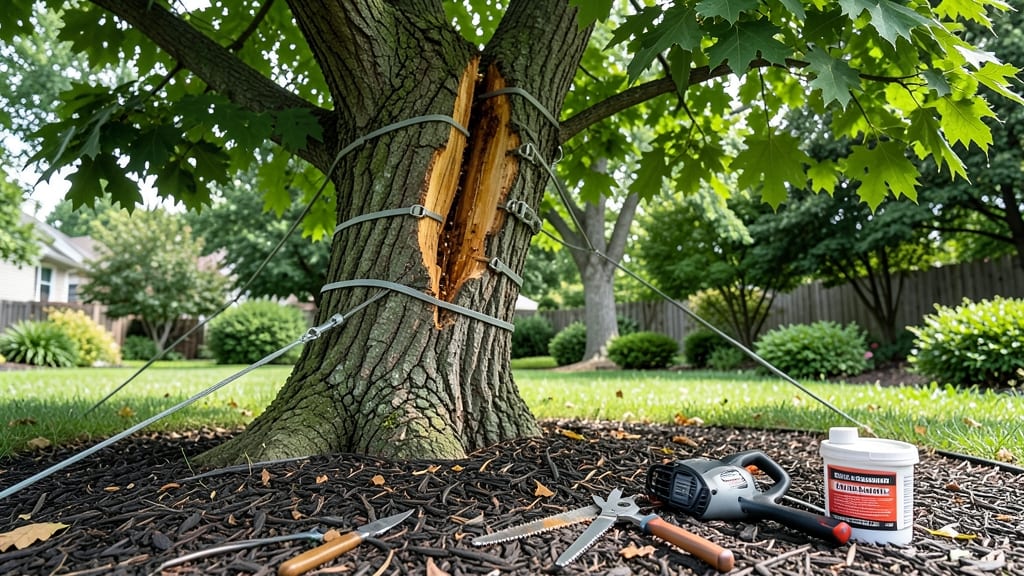
Your tree broke in half—now it’s time to act before the storm does. 🌳 The good news? With the right moves, you can stabilize the damage, assess what’s salvageable, and give your tree a fighting chance to recover stronger than before.
I’ve fixed splits in oaks, maples, and even my stubborn old apple tree, and the key is acting fast while keeping safety top priority.
The first step is securing what’s left standing—temporarily. If the break is clean but unstable, you might need to cable the trunk to a sturdy support or brace the split with wooden struts (think of it like a cast for your tree).
For deep cracks or multiple splits, prune back damaged branches to reduce weight and stress on the remaining structure. The goal? Prevent the break from getting worse while you figure out long-term fixes.
Not all trees make a full comeback, but many can heal surprisingly well with proper care. Focus on watering deeply (but not drowning the roots) and avoiding heavy pruning until you’re sure the tree is stable.
If the split runs more than halfway through the trunk or the tree is leaning dangerously, it’s time to call an arborist—some damage is beyond DIY repair.
Long-term, you’ll monitor for signs of recovery like new growth at the break or sealed-over cracks. Patience is key—some trees take years to fully stabilize, but with the right approach, you might just save a beloved shade provider or fruit-bearing giant.
Here’s how to decide if your tree can make it back.
Root Causes Behind Tree Splits
Understanding why a tree breaks in half is the first step toward preventing it—and ensuring your landscape stays safe and healthy. Trees don’t snap randomly; they succumb to a mix of natural stress, environmental factors, and poor maintenance.
Below, we break down the key reasons behind this structural failure, with actionable insights to help you identify risks before they escalate.
Trees are resilient, but they have their limits. High winds, ice storms, and heavy snow are the most common culprits behind sudden splits. Here’s how they weaken a tree’s structure:
- Wind Stress: Strong gusts act like a lever, exerting torsional force (twisting) on the trunk.
If the root system isn’t deep or stable enough, the tree can’t anchor itself, leading to a clean break—often at the weakest point (like a narrow trunk or a previous pruning cut). - Actionable tip: 🌡️ Check for "flagging"—a tree leaning heavily in one direction may already be compromised.
Prune to reduce wind resistance and stake young trees in storm-prone areas.
- Ice Accumulation: When ice builds up on branches, it adds dead weight (up to 50 lbs per cubic foot!).
The sudden load can cause limbs to snap under their own weight, especially if the tree is already water-stressed. - Pro move: 💡 Inspect for "ice cracks"—if you see vertical splits in the bark after a storm, the tree may have internal damage.
Remove hazardous branches before the next freeze.
- Snow Load: Heavy, wet snow (like the kind that sticks to branches) can double a limb’s weight. Evergreens are particularly vulnerable because their needles trap moisture, creating a dangerous ice-snow sandwich. - Prevention hack: ✨ Shake snow off large branches gently after storms to reduce stress.
Avoid this with weak or diseased trees—it can do more harm.
A tree that looks healthy on the outside might be rotting from within. Fungal infections, bacterial diseases, and even insect infestations can hollow out the trunk, making it prone to splitting under minimal stress.
- Heart Rot: Fungi like Fomes fomentarius (the "hoof fungus") or Armillaria (honey mushroom) break down the inner wood, turning it to mush.
By the time you see conks (shelf fungi) on the trunk, the structural integrity is already compromised. - Red flag: 🚨 Hollow-sounding knocks when tapping the trunk or mushrooms growing at the base. These trees should be removed safely by a professional.
- Bacterial Cankers: Diseases like bacterial leaf scorch or canker create weak spots in the bark and cambium layer.
These areas are prime candidates for splits, especially during sudden temperature swings. - Fix it: 🔪 Prune infected branches 6+ inches below the canker (sterilize tools with rubbing alcohol to prevent spread). Avoid heavy pruning—it stresses the tree further.
- Insect Damage: Wood-boring beetles (like emerald ash borer) and termites create tunnels that weaken the trunk. Over time, these tunnels reduce load-bearing capacity, making the tree more likely to split in storms. - Defense strategy: 🛡️ Monitor for exit holes, sawdust-like frass, or wilting leaves.
Treat with systemic insecticides (like imidacloprid) early in the season.
Improper pruning is a silent killer of tree strength. Cutting at the wrong time, removing too much wood, or making jagged wounds can turn a tree into a splitting hazard.
- Topping or Heading Cuts: When branches are severed flush to the trunk (or worse, above a lateral branch), the tree forms weak, stubby regrowth that’s prone to splitting.
These cuts also expose the vascular system, inviting decay. - Do this instead: ✂️ Use the "3-cut method"—make the first cut 12–18 inches out from the trunk, then a second cut to avoid tearing the bark, and finally remove the branch cleanly.
- Over-Pruning: Removing more than 25% of the canopy in one season stresses the tree, reducing its ability to transport water and nutrients.
A weakened tree is far more likely to split in high winds. - Golden rule: 🌿 Never prune more than 25% of a tree’s foliage in a single year. Spread heavy pruning over 2–3 years if needed.
- Improper Wound Closure: Large pruning wounds (over 1.5 inches in diameter) don’t heal like small ones—they remain open, creating entry points for pests and disease.
Over time, the callus tissue (the tree’s natural seal) fails, leading to internal rot. - Healing hack: 🎯 Use a pruning sealant (like Tanglefoot Tree Wound Pruning Sealer) only on wounds over 2 inches. For smaller cuts, let the tree heal naturally—sealants can trap moisture and worsen decay.
Even the healthiest trees age out of their structural prime. Older trees develop natural weaknesses that make them more susceptible to splitting:
- Co-Dominant Stems: When two (or more) equal-sized leaders grow from the trunk, they compete for dominance, creating a V-shaped crotch that’s prone to splitting.
This is common in maples, oaks, and elms. - Solution: 🌱 Prune one leader when the tree is young (under 10 years old) to encourage a single, strong trunk. If the tree is mature, avoid heavy pruning—the risk of splitting increases.
- Included Bark: When two branches grow too closely together, their bark fuses abnormally, creating a weak junction. This is a major split risk, especially in storms. - Spot it: Look for ridges or bark growing between branches.
If the angle between branches is less than 45 degrees, it’s a high-risk zone.
- Root Girdling: If roots circle the trunk (often from poor planting or root-bound nursery stock), they strangle the tree’s growth. This leads to weak wood formation and asymmetrical splits. - Prevent it: 🌳 Inspect the root flare (where roots meet the trunk).
If you see roots wrapping around the trunk, consult an arborist for root collar excavation.
Sometimes, man-made factors accelerate a tree’s demise. From construction damage to improper planting, these mistakes turn trees into time bombs.
- Construction Damage: Root severing (from trenching or digging) or trunk wounds (from lawnmowers or vehicles) create entry points for decay.
Even soil compaction from heavy machinery can strangle roots, reducing stability. - Avoid this: 🚜 Keep construction equipment at least 15 feet from the trunk and avoid digging within the tree’s drip line. Use root barriers if necessary.
- Improper Planting: Trees planted too deep (burying the root flare) or in poor soil struggle to establish strong roots.
This makes them top-heavy and prone to splitting in winds. - Planting pro tip: 🌱 Dig a hole twice as wide as the root ball but no deeper. Ensure the root flare is visible above ground.
- Vibration from Traffic or Machinery: Constant shaking (like from nearby roads or construction) fatigues the wood fibers, making the tree more likely to split suddenly.
- Buffer zone: 🛣️ Plant trees at least 30 feet from high-traffic areas or use vibration-dampening barriers.
Final Note: Most tree splits are preventable with proactive care. Regular inspections, proper pruning, and addressing weaknesses early can save your tree—and your property—from disaster. 🚨 If you spot any of these red flags, act fast: consult a certified arborist before the next storm hits.
Fixing and Preventing Tree Splits
A snapped tree isn’t just an eyesore—it’s a safety hazard and a sign your tree needs urgent care. Whether the split happened due to storm damage, weak wood, or poor growth habits, here’s how to assess, repair, and prevent future breaks for a healthier, stronger tree.
Before jumping into repairs, evaluate the severity of the split. A partial break may be salvageable, while a complete snap could mean removal. Here’s how to tell:
- 🔍 Check the Split Type:
- Clean Break: If the tree snapped sharply (like a dry branch), the wood may still be structurally sound below the break.
- Ragged Tear: A jagged split suggests weak wood or rot—this tree may need more extensive intervention.
- Leaning but Intact: If the trunk is split but still connected, it might be stabilized with proper support.
- 🌿 Inspect for Rot or Pests: Use a knife to gently scrape a small section of the split. If you see mushrooms, soft wood, or insect tunnels, the tree may have internal decay. In this case, removal might be the safest option.
- 📏 Measure the Height & Weight: If the break is high or the remaining section is heavy, you’ll need professional help for safe removal or stabilization.
Not all splits mean goodbye to your tree! If the root system and lower trunk are healthy, you can cable and brace the split to prevent further damage.
🔧 How to Cable a Split Trunk
(Best for partial splits where the tree is still standing but unstable.)
- 🔨 Clear the Area: Remove any broken branches or debris within 10 feet of the tree. Wear gloves and safety glasses—sharp wood can cause injuries!
- 📏 Find the Right Spots:
- Locate the widest part of the split (this is where the cable will bear the most weight).
- Drill two holes (about 1.5 inches wide) on either side of the split, above and below the break, angled slightly upward.
- 🪢 Install the Cables:
- Thread a steel tree cable (¼-inch diameter) through the holes.
- Use turnbuckles (adjustable tension devices) to tighten the cable gradually—never over-tighten, or you’ll crush the trunk.
- Secure the ends with lag bolts or cable anchors.
- 🌱 Monitor the Tree:
- Check the cables every 6 months for rust or loosening.
- If the split widens or the tree leans dangerously, consult an arborist.
⚠️ When NOT to Cable:
- If the tree is dead or hollow (cabling won’t help).
- If the split is near the base (roots may not support the weight).
- If the tree is leaning at an extreme angle (risk of toppling).
Even if you’re keeping the tree, pruning can reduce future risks by improving structure and weight distribution.
✂️ What to Prune & When
| Issue | Solution | Best Time to Prune |
|---|---|---|
| Dead or Hanging Branches | Remove any branches that are dry, cracked, or dead—these are weak points. | Winter (dormant season) |
| Overgrown Canopy | Thin out crossing or rubbing branches to reduce weight and friction. | Late winter/early spring |
| Sucker Growth | Cut back fast-growing shoots at the base—they drain energy from the trunk. | Spring or fall |
| Co-Dominant Stems | If the tree has two main trunks growing upward, one may need removal to prevent future splits. | Gradual over 2-3 years |
💡 Pro Tip: Never remove more than 25% of the canopy in one season—this stresses the tree. Spread pruning over 2-3 years for best results.
A weak base is often the root cause of splits. Strengthen it with these low-cost, high-impact fixes:
- 🌱 Mulch Properly:
- Spread 2-4 inches of mulch in a 3-foot radius around the trunk (but keep it 6 inches away from the bark to prevent rot).
- Use wood chips or shredded bark—avoid rocks or plastic.
- 💧 Water Deeply (But Not Too Much):
- Deep watering (1-2 inches per week) encourages strong root growth.
- Avoid overwatering, which leads to weak, rot-prone wood.
- 🌿 Support Young Trees:
- If your tree is newly planted, use a tree stake for the first year to prevent wind rock.
- Never stake for more than a year—this can weaken roots.
Some splits are too risky to DIY. Contact a professional if: ✅ The tree is leaning dangerously (45° or more). ✅ The split is near the base (roots may not hold). ✅ The tree is hollow, rotting, or pest-infested. ✅ The break is too high for safe cable installation.
A certified arborist can:
- Safely remove the tree if needed.
- Assess internal rot with a resistograph (a drilling tool that checks wood density).
- Recommend species-specific care (some trees, like willows or elms, are prone to weak wood).
The best "repair" is prevention. Keep your tree strong with these habits:
🔹 🌡️ Choose the Right Tree for Your Climate:
- Avoid weak-wooded species (like willows, cottonwoods, or silver maples) in storm-prone areas.
- Opt for strong, flexible trees like oak, hickory, or sugar maple for high-wind zones.
🔹 🌱 Plant Properly:
- Dig a wide hole (2-3x wider than the root ball) to encourage root spread.
- Avoid deep planting—the root flare (where roots meet the trunk) should be visible above ground.
🔹 🌪️ Protect Against Storms:
- Thin the canopy in high-wind areas to reduce sail effect.
- Remove dead branches before storm season (fall/winter).
🔹 📅 Regular Checkups:
- Inspect your tree twice a year (spring and fall) for cracks, rot, or pest signs.
- Mark weak spots with spray paint so you can monitor them.
A split tree can often be saved with the right care—but rushing repairs can do more harm. Take your time, assess the damage, and prioritize safety over saving the tree if it’s beyond help.
With proper pruning, cabling (when needed), and preventive care, your tree can grow stronger and avoid future breaks.
💡 Remember: A well-maintained tree isn’t just aesthetic—it’s an investment in safety and longevity.
Frequently asked questions about a broken tree
Can I save a tree that broke in half during a storm?
It depends on the break and root health. If the split is clean and the base is stable, you can try cabling the trunk for support. For partial splits where the tree remains upright, professional bracing may work. However, if the tree is leaning dangerously, hollow, or shows signs of rot, removal is safer. Always inspect for internal damage first.
How do I know if my tree has internal rot after a break?
Look for soft, spongy wood when you scrape the split area, or check for mushrooms growing at the base. A hollow-sounding knock when tapping the trunk is another red flag. If you find these signs, the tree is likely structurally compromised and may need removal by an arborist.
Is it safe to DIY tree cabling for a split trunk?
Only attempt cabling if you're comfortable with tools and understand tree mechanics. Use proper ¼-inch steel cables with turnbuckles, and never over-tighten. If the split is near the base, the roots may not support the weight—consult an arborist first. Improper cabling can cause more damage than the original break.
What's the best time of year to prune a damaged tree?
Prune during the tree's dormant season (late fall to early spring) to minimize stress. Remove dead, hanging, or crossing branches first, then thin the canopy gradually. Avoid heavy pruning after a storm—wait until the tree has stabilized to prevent further weakening.
How can I prevent my other trees from splitting in future storms?
Start with proper pruning to reduce wind resistance, and avoid topping branches. Choose storm-resistant species like oak or hickory for your climate, and mulch properly to support root health. Regular inspections (twice yearly) help catch early signs of weakness before storms hit.