
Trees
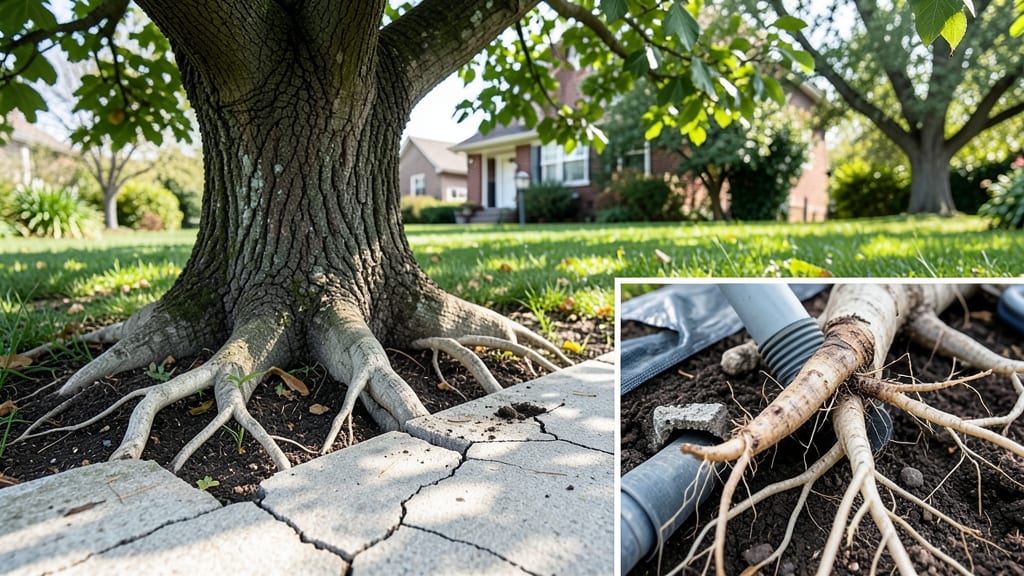
Apple tree roots do cause damage by spreading aggressively up to 30 feet wide and 6-8 feet deep, often cracking sidewalks, damaging foundations, and competing with nearby plants for water and nutrients. Young trees develop shallow roots, while mature trees grow deeper but remain aggressive in growth patterns.
Apple tree roots can wreak havoc on your property if not properly managed. 🌳 The lateral spread alone can outpace most homeowners' expectations, often reaching beyond the tree's canopy.
This aggressive growth pattern isn't just about width—roots also penetrate deep, seeking moisture and nutrients that might otherwise nourish your lawn or garden. I've seen cases where mature apple trees lifted concrete pavers or caused plumbing issues when roots invaded underground pipes.
What makes this particularly tricky is how root behavior changes with age. Young trees focus on spreading horizontally to establish dominance, while older specimens develop deeper taproots that can create structural risks.
The key to prevention lies in strategic planting—keeping trees at least 25-30 feet from foundations—and using physical barriers when necessary. Regular soil checks can also reveal early signs of root pressure before damage occurs.
💡 In This Article
- How Apple Tree Roots Spread and Their Growth Patterns
- Preventing Apple Tree Root Damage to Structures and Landscaping
How apple tree roots spread and their growth patterns
Apple tree roots develop through a complex system where the primary taproot gives way to a network of secondary roots as the tree matures. Young trees (under 5 years) focus on lateral spread, sending out feeder roots within 12-18 inches of the surface to capture surface moisture.
These shallow roots can extend 2-3 times the width of the tree's canopy, which is why you often see damage to sidewalks or lawns near young specimens. The root density in this zone is highest, with up to 70-80% of roots concentrated in the top 12 inches of soil.
The transition happens around age 5-7 when the tree begins developing a deeper root system. Mature apple trees (10+ years) can push roots 6-8 feet deep, though the majority still remain within 3 feet of the surface.
This deeper penetration explains why older trees sometimes damage underground utilities or foundations. The root growth isn't uniform—it follows moisture gradients, often growing toward water sources like irrigation lines or plumbing leaks. In drought conditions, roots may grow 20-30% faster to seek out water, increasing their destructive potential.
Seasonal growth cycles also play a critical role. Root expansion peaks in early spring when soil temperatures reach 50-55°F, coinciding with new shoot growth. This synchronized growth means roots are most aggressive during the tree's most active periods.
The root-to-shoot ratio is typically 1:10—for every pound of above-ground growth, there's about 0.1 pounds of root growth—but this ratio shifts dramatically in poor soil conditions, where roots may grow 50% more to compensate for nutrient deficiencies. 🌱
Soil composition dramatically affects root behavior. In clay soils, roots grow more horizontally due to poor drainage, while sandy soils encourage deeper penetration. Compacted soil forces roots to grow along the surface, increasing surface damage risks.
Organic matter content also matters—roots in well-amended soil can spread 15-20% wider than in poor soil, as they don't need to work as hard to find nutrients. This is why mulch rings around trees can actually increase root spread while reducing surface damage potential.
What most people don't realize is how root competition works. Apple trees have a high water uptake rate—a mature tree can consume 50-100 gallons of water daily during peak growth. This aggressive water extraction creates dry zones in the surrounding soil, which stresses nearby plants and lawns.
The root zone's acidity (typically pH 5.5-6.5) also inhibits many competing plant species, giving apple trees a natural advantage in mixed landscapes.
The most damaging roots are actually the smallest—those under 1/8 inch in diameter. These fine feeder roots make up 80% of the root system but are responsible for most of the structural damage when they grow into cracks or lift pavers.
Their high surface area allows them to exert significant pressure, even though individually they're not very strong. This is why you'll often see damage appear suddenly—it's not the thick roots causing the problem, but the massive network of fine roots working together.