
Pruning
A leaning tree isn’t just an eyesore—it’s a safety hazard waiting to happen. 🌳 I’ve seen too many trees topple after storms or years of ignored imbalance, and the fix isn’t as complicated as you’d think.
The key is catching it early, assessing the root cause (literally and figuratively), and taking simple steps to stabilize it before it becomes a structural nightmare.
The real culprits are usually wind, poor soil drainage, or uneven root growth—none of which require a degree in arboriculture to address.
You’ll start by checking the lean angle (less than 15° is usually manageable), testing soil stability around the base, and looking for signs of root rot or shallow roots. Most fixes involve staking, strategic pruning, or soil adjustments—none of which require heavy machinery or a weekend off.
By the end, your tree will stand tall and steady, with roots anchored properly and branches balanced. The best part? You’ll save hundreds in potential damage costs while giving your yard a safer, sturdier look. Even if it’s a mature tree, the right techniques can make all the difference.
For severe leans or large trees, though, calling an arborist is the smarter move. But for most home gardeners, this is a foolproof way to fix a leaning tree without breaking the bank or the back. Let’s get started with the tools you already have.
Root of the Problem
When your tree starts to lean—whether it’s a gentle tilt or a dramatic slant—it’s rarely a random act of nature. Instead, it’s usually a sign that something fundamental is off below ground or within the tree’s structure.
Understanding the why behind a leaning tree is the first step to fixing it safely. Here’s a breakdown of the most common causes, backed by science and practical insights.
A tree’s roots are its anchor, and if they’re not strong or deep enough, the tree will lean like a drunkard at last call. This often happens with:
- Young trees: Their root systems are still developing. Without proper planting depth (roots buried too shallowly), they struggle to stabilize against wind or gravity.
- Poor soil conditions: Compacted, rocky, or waterlogged soil restricts root growth. Roots can’t spread outward or downward, leaving the tree top-heavy and prone to leaning.
- Improper planting: If a tree is planted too deep (burying the root flare) or too shallow (exposing roots), it disrupts the natural balance. The root flare—where roots meet the trunk—should sit just above ground level.
Actionable fix: If your tree is young, improve soil aeration with organic matter (compost or mulch) and avoid compacting the soil around it. For mature trees, consult an arborist to assess root health.
Trees aren’t just leaning because they’re lazy—they’re often reacting. Chronic exposure to strong, unidirectional winds can cause a tree to grow at an angle to reduce wind resistance. This is especially true for:
- Exposed locations: Trees in open fields, near coastlines, or on hilltops experience relentless wind pressure, forcing them to lean into the dominant wind direction.
- Seasonal shifts: Young trees planted in late fall or early spring may lean toward the sun’s strongest direction (south in the Northern Hemisphere) to maximize light absorption.
- Storm damage: A single severe storm can uproot or bend a tree, and if the roots don’t recover, the lean becomes permanent.
Actionable fix: If wind is the culprit, consider planting windbreaks (like shrubs or fences) on the exposed side. For storm-damaged trees, prune dead branches and monitor for further instability.
Sometimes, a tree leans because it’s growing that way intentionally. Uneven growth can stem from:
- Genetics: Some tree species (like willows or weeping cherries) naturally grow at angles. Others may have a genetic quirk called reaction wood, where the tree produces extra wood on one side to counteract imbalance.
- Light competition: Trees growing near buildings, fences, or other trees may lean toward light sources, stretching their branches in one direction.
- Root restriction: Underground obstacles (like buried pipes, sidewalks, or rocks) can force roots to grow unevenly, causing the trunk to tilt.
Actionable fix: If the lean is due to genetics or light, it’s usually harmless. For root-restricted trees, avoid digging near the base and consider root aeration to encourage balanced growth.
Hidden threats like pests or pathogens can weaken a tree’s structural integrity, leading to leans. Common culprits include:
- Root rot: Fungal infections (like Armillaria or Phytophthora) decay roots, reducing their ability to anchor the tree. Symptoms include mushrooms at the base or spongy, discolored wood.
- Boring insects: Beetles or termites can hollow out roots or the trunk, creating weak spots that cause leaning.
- Canker diseases: Fungal or bacterial infections (e.g., Nectria) can girdle the trunk, disrupting nutrient flow and stability.
Actionable fix: If you suspect disease or pests, inspect the base for signs like oozing sap, sawdust-like frass, or unusual growths. Consult an arborist for treatment (e.g., fungicides, insecticides, or pruning to remove infected areas).
Sometimes, the lean is entirely our fault. Poor maintenance practices can turn a straight tree into a leaning tower of Pisa:
- Improper pruning: Removing too many branches on one side disrupts the tree’s center of gravity, causing it to tilt.
- Soil compaction from foot traffic: Heavy machinery, construction, or even frequent walking near the tree can compress soil, limiting root expansion.
- Guying or staking mistakes: If a tree is staked improperly (e.g., too tightly or for too long), it can become dependent on the support and lean when removed.
Actionable fix: Avoid pruning more than 25% of a tree’s foliage at once. If soil is compacted, use a garden aerator or top-dress with mulch. For staked trees, remove supports once roots establish (usually after 1–2 years).
Fixing Leaning Trees Safely
A leaning tree isn’t just an eyesore—it can pose serious risks to your property, power lines, and even safety. The good news? Most leaning trees can be stabilized or corrected with the right approach.
Below, we break down practical solutions tailored to the root cause of your tree’s tilt, along with prevention tips to keep it standing strong for years.
1. Shallow or Unbalanced Root System
If your tree leans because its roots aren’t deep or evenly distributed, soil compaction, poor drainage, or young age could be to blame. Here’s how to address it:
- 🔥 Add Support with Guying or Cabling
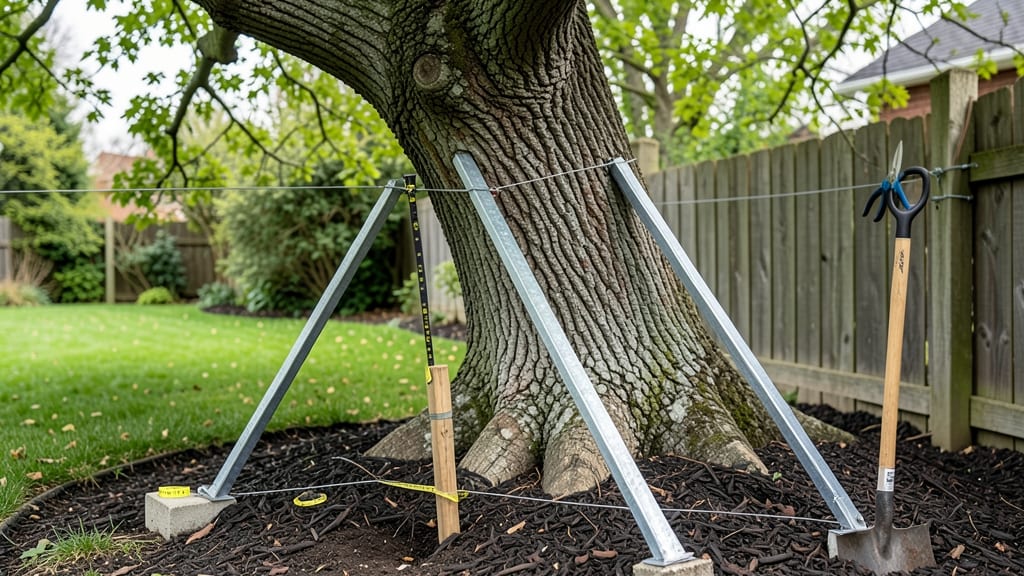
- Install steel cables or guy wires anchored into the ground at a 45° angle, securing them to the trunk with tree straps (never nails or spikes—this damages bark).
- For younger trees, use softwood stakes wrapped in rubber to avoid root damage.
- Pro Tip: 💡 Check tension annually—loose cables won’t hold the tree in place.
- 🌱 Improve Soil & Root Health
- Loosen compacted soil around the base (but never dig near the trunk—this can girdle roots).
- Amend the soil with organic matter (compost or mulch) to encourage deeper root growth.
- Water deeply 1-2 times per week during dry spells to promote root expansion.
- ⏰ Prevention for Future Plantings
- Plant trees in well-drained soil and avoid areas with high foot traffic or construction.
- Choose native species—they adapt better to local soil conditions.
2. Wind or Storm Damage
If the lean happened suddenly (e.g., after a storm), the tree may have broken roots or a compromised trunk. Act fast to prevent further damage.
- 👨🍳 Assess the Damage First
- If the trunk is cracked or split, consult an arborist—some trees can’t be saved.
- If roots are exposed or broken, prune dead branches and stabilize the tree immediately.
- 🔪 Emergency Stabilization
- Brace the trunk with a tree support system (like a tree cradle or brace rod) to prevent further leaning.
- Remove debris around the base to avoid pest infestations or rot.
- 🌡️ Long-Term Wind Protection
- Plant windbreak shrubs on the exposed side.
- Avoid pruning too much foliage—this reduces wind resistance.
3. Poor Planting or Construction Impact
If the tree was planted at an angle or nearby excavation disturbed its roots, it may never fully straighten. Here’s how to manage it:
- 🥘 Adjust Growth with Pruning (For Young Trees)
- Selective pruning on the leaning side can encourage new growth on the opposite side, helping the tree grow straighter over time.
- Warning: ⚠️ Never top the tree—this weakens the structure.
- 📊 Professional Bracing for Mature Trees
- For large, established trees, an arborist may recommend dynamic support systems (like air spades to expose and stabilize roots).
- If the lean is too severe, the tree may need partial removal for safety.
- 🎯 Prevention for Future Projects
- Call an arborist before digging—roots can extend far beyond the canopy.
- Avoid planting near sidewalks or driveways—compacted soil accelerates leaning.
4. Disease or Pest Weakness
If the lean is due to root rot, fungus, or borers, the tree may not recover. Focus on removal or containment.
- 🔥 Treat the Underlying Issue
- Fungal infections? Apply copper-based fungicides and improve drainage.
- Borer damage? Inject systemic insecticides (best done by a pro).
- ✨ When to Remove the Tree
- If the tree is hazardous (dead, splitting, or leaning dangerously), removal is safest.
- Stump grinding prevents regrowth and keeps the area safe.
- 💪 Prevention Tips
- Inspect trees annually for signs of decay (mushrooms at the base, oozing sap).
- Keep mulch 6+ inches away from the trunk to prevent moisture buildup.
Before tackling a leaning tree, ask yourself: ✅ Is the tree still alive? (Scratch the bark—green underneath = living.) ✅ Is it a safety hazard? (If branches hang over structures, act fast.) ✅ Do I need a pro? (For large or mature trees, always consult an arborist.)
Remember: Some leans are natural (trees grow at angles, especially in forests). Only intervene if the tree is unstable or at risk. With the right care, your leaning tree can stay safe and healthy for decades!
Frequently asked questions
Can I fix a leaning tree myself, or do I always need a professional?
You can handle minor leans (less than 15°) yourself, especially for young trees. Use softwood stakes or cables for support and improve soil health with compost. For mature trees, large leans (20°+), or signs of disease, call an arborist—they can assess root health and recommend professional bracing or removal if needed.
How tight should I make the guy wires or stakes when stabilizing a tree?
Just snug enough to prevent movement—think of it like a gentle hug, not a straitjacket. Use rubber padding between the wire and bark to avoid damage, and check tension every 3-6 months. Too tight can girdle the trunk, while too loose won’t provide support. For young trees, stakes should allow slight trunk sway to encourage natural strength.
Will pruning help straighten a leaning tree?
Only if the lean is due to uneven growth or poor pruning habits. For young trees, prune 25% or less of the foliage on the leaning side to encourage upward growth. Avoid topping the tree—this creates weak spots. For mature trees, pruning won’t fix structural issues but can improve overall health. Focus on removing dead branches and balancing the canopy.
How do I know if my leaning tree is safe to keep?
Check for these red flags: Cracks in the trunk, mushrooms at the base (sign of rot), dead branches, or a lean over 30°. If the tree is alive (green bark when scratched) but otherwise stable, minor fixes may work. If it’s a hazard (hanging over structures), removal is safest. When in doubt, consult an arborist—they can assess stability with specialized tools.
Can I plant a new tree to "fix" a leaning one?
Not directly—new trees won’t correct an existing lean. However, planting a windbreak shrub on the exposed side can reduce stress on the leaning tree. For long-term stability, focus on improving the original tree’s root system with aeration, mulch, and proper watering. If the lean is severe, consider replacing the tree entirely with a species better suited to your soil and location.