
Plants
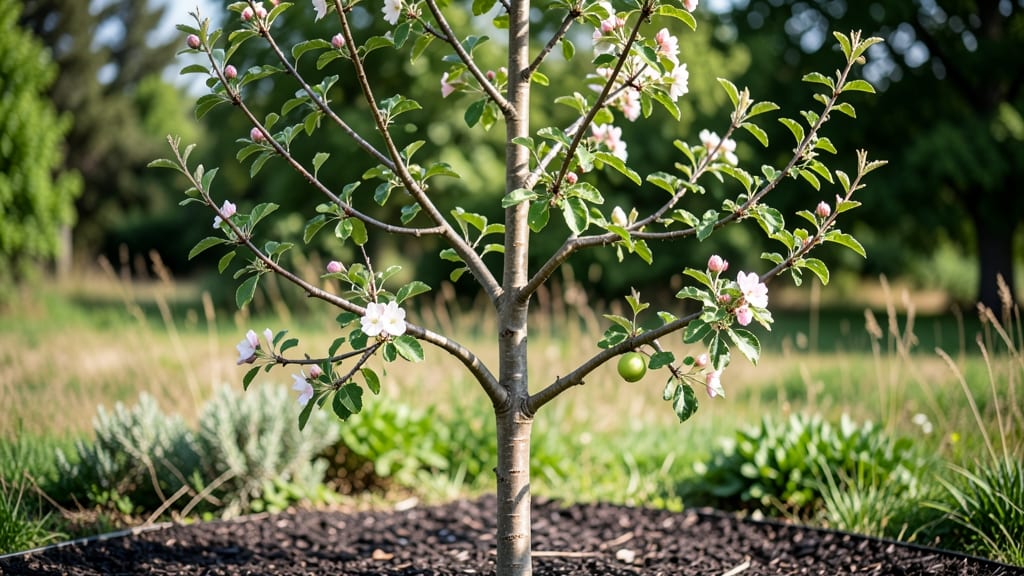
A young apple tree looks like a slender sapling with smooth, grayish-brown bark and small, oval leaves that have serrated edges. Its branches spread in a vase-like shape, and it grows to 3–6 feet tall in its first year before thickening as it matures.
A young apple tree's appearance is one of its most distinctive features. 🌱 The leaves, which are typically 1–3 inches long with pointed tips and fine serrations along the edges, help distinguish it from similar trees like crabapples or ornamental pears.
The bark starts smooth but develops slight ridges as the tree ages, while the vase-shaped branching pattern—with main stems radiating outward—creates a balanced silhouette that's easy to spot in orchards or gardens.
What makes these trees particularly recognizable is their early growth pattern. In their first year, they focus on vertical height, often shooting up 3–6 feet while developing a strong central leader.
By year three, you'll notice lateral branches starting to form, and by year five, the tree begins producing its first blossoms—typically white or pink—before developing fruit. This rapid structural development is what sets young apple trees apart from slower-growing varieties.
Pruning plays a crucial role in shaping these early stages. 🌿 Removing competing branches and encouraging an open center helps prevent disease and improves air circulation, which is especially important as the tree transitions from sapling to mature fruit producer.
The key is to intervene early—before the tree establishes dominant branches that become difficult to modify later.
💡 In This Article
- Identifying Young Apple Tree Leaves and Bark Features
- Growth Stages of a Young Apple Tree by Height and Branch Development
Identifying young apple tree leaves and bark features
The leaves of a young apple tree are one of its most defining characteristics. They typically measure 1–3 inches long and 0.75–1.5 inches wide, with an oval shape that tapers to a pointed tip.
The edges feature fine, saw-like serrations—about 10–15 teeth per inch—that create a distinctive scalloped appearance. These leaves are medium green on top and slightly paler underneath, with a smooth, almost waxy texture that helps reduce water loss during dry spells.
One key identifying feature is the leaf's vein pattern. Young apple tree leaves have a central midrib with 5–7 pairs of secondary veins that branch out at roughly 45-degree angles, creating a web-like structure.
This pattern differs from crabapple leaves, which often have more pronounced veins and a slightly more rounded shape.
The bark of young apple trees is another telltale sign: it starts as smooth and grayish-brown but develops subtle horizontal lenticels—tiny, raised pores—that allow gas exchange. 🌿 Over time, these lenticels become more pronounced, and the bark may develop slight ridges as the tree matures.
Comparing young apple trees to similar species helps avoid confusion. For example, ornamental pear trees have leaves with a more glossy finish and often exhibit a reddish tint when young, while crabapple leaves tend to be smaller (0.5–2 inches long) with a more irregular serration pattern.
The vase-shaped branching structure of apple trees—where main branches spread outward at about 45–60 degrees from the trunk—is another distinguishing factor. This growth habit creates an open canopy that allows sunlight to reach lower branches, promoting healthier fruit production as the tree ages.
The texture of young apple tree leaves also provides clues. When rubbed between fingers, they feel slightly rough due to tiny hairs along the veins, unlike the smoother leaves of many ornamental trees. Additionally, the leaves emit a faint, sweet aroma when crushed—a subtle hint of the tree's future fruit.
This sensory detail, combined with the leaf shape and bark characteristics, makes young apple trees relatively easy to identify once you know what to look for.
As the tree matures, these features evolve. By year three, the bark begins to develop more pronounced ridges, and the leaves grow slightly larger (2–4 inches long). The serrations become more defined, and the overall leaf shape maintains its oval form but with a broader base.
Understanding these gradual changes helps gardeners and orchard managers track the tree's development and intervene with pruning or fertilization at the right stages. 🌱
One advanced tip for identification is to look for bud scales. Young apple trees have oval-shaped buds that are covered in overlapping scales, which help protect the developing leaves and flowers during winter.
These buds are typically 0.25–0.5 inches long and are arranged alternately along the branches, another feature that sets them apart from trees like hawthorn, which have more clustered buds.