
How To
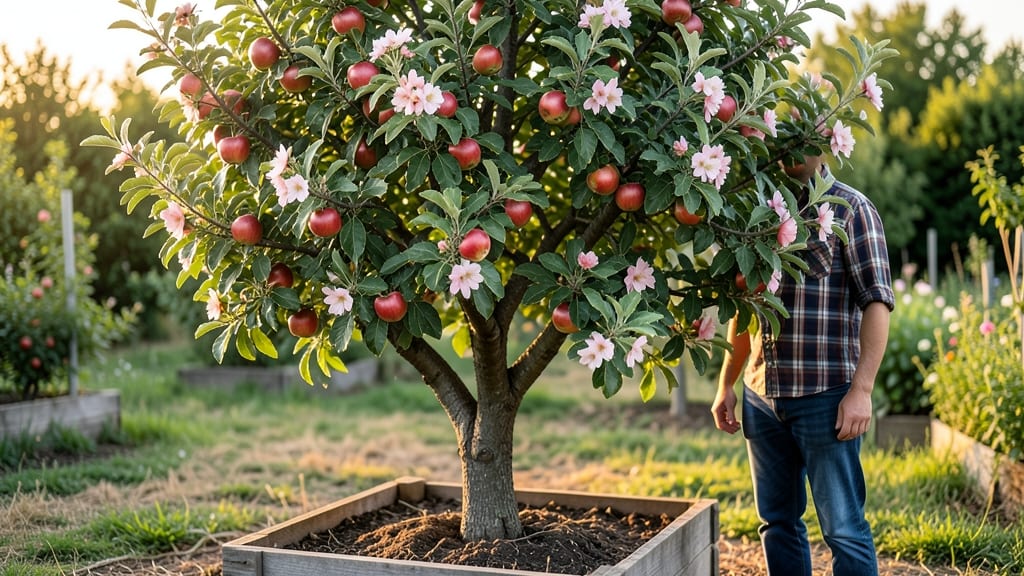
A Fuji apple tree 🍎 can grow anywhere from 15 to 25 feet tall at maturity, but the final height depends on the variety and how you care for it.
If you're dreaming of homegrown Fuji apples but wondering whether they'll dwarf your backyard or tower over your fence, the answer depends on more than just genetics—it’s about variety, pruning, and growing conditions.
Standard Fuji apple trees reach their full height over 10 to 15 years, while dwarf varieties stay under 8 feet with the right rootstock and pruning. That means you can grow them in containers or small gardens without sacrificing fruit production.
Below, we’ll cover the height ranges for each type, how to control growth through pruning, and the key factors that influence how tall your Fuji apple tree will grow.


Fuji apple tree height by variety: standard vs dwarf vs semi-dwarf options
Choosing the right Fuji apple tree size is the first step in planning your orchard or backyard garden. The mature height of your tree depends entirely on its rootstock, which determines whether it grows as a standard, semi-dwarf, or dwarf variety.
Each option offers different benefits for space, yield, and maintenance.
Standard Fuji apple trees can reach 12 to 16 feet at maturity, making them ideal for large properties or commercial orchards. Meanwhile, dwarf varieties stay between 6 to 8 feet, perfect for small yards or container growing.
Semi-dwarf trees strike a balance at 8 to 10 feet, offering a compromise between size and productivity.
Here’s how each variety compares in terms of height, spacing, and fruit production:
| Variety | Mature Height | Spacing Needs | Yield per Tree | Rootstock Examples |
|---|---|---|---|---|
| Standard | 12–16 ft | 20–25 ft apart | 50–100 lbs | MM.106, MM.111 |
| Semi-Dwarf | 8–10 ft | 12–15 ft apart | 30–60 lbs | M.9, M.26 |
| Dwarf | 6–8 ft | 8–10 ft apart | 15–30 lbs | B.9, M.27 |
The rootstock you choose directly influences how tall your Fuji apple tree will grow. For example, trees grafted onto MM.106 rootstock will reach full standard height, while those on B.9 remain dwarf-sized. Always check the rootstock label when purchasing, as this determines both size and vigor.
If you’re working with limited space, dwarf Fuji apple trees are the best choice, but be prepared for slightly lower yields. Semi-dwarf varieties offer a happy medium, producing more fruit while staying manageable. Standard trees, while productive, require ample space and regular pruning to maintain health.
Spacing is critical for airflow and sunlight exposure. Plant standard Fuji trees 20–25 feet apart to prevent overcrowding, while dwarf varieties need only 8–10 feet. Proper spacing reduces disease risk and ensures each tree receives adequate nutrients and light for optimal growth.
Another factor to consider is fruit production timing. Dwarf and semi-dwarf trees often bear fruit earlier than standard varieties, sometimes within 2–3 years of planting, compared to 4–5 years for standard trees. This makes smaller varieties ideal for impatient gardeners eager to harvest their first crop.
For urban or container gardening, dwarf Fuji apple trees thrive in large pots (at least 15–20 gallons), provided they get full sun and consistent watering. Just remember that container-grown trees may need more frequent fertilization to compensate for limited root space.
No matter which variety you choose, regular pruning and training will help control height and shape. Prune in late winter or early spring to remove dead or crossing branches, and use a central leader or open-center structure to guide growth patterns.
With the right variety and care, your Fuji apple tree will thrive—whether it’s a towering standard or a compact dwarf. Start small with a dwarf or semi-dwarf if space is limited, or go for a standard if you have room for a classic orchard experience.
How to control Fuji apple tree height through pruning and training
Pruning isn't just about keeping your Fuji apple tree manageable—it's the key to shaping its growth habit and ensuring those sweet, crisp fruits stay within reach. Whether you're working with a standard variety (15-25 ft) or a dwarf cultivar (6-8 ft), strategic pruning can reduce height by 30-50% over time.
The secret lies in two training methods: central leader (single trunk) and open-center (multiple branches).
For compact growth, the open-center method works best. This approach encourages a spreading canopy rather than vertical growth, making it ideal for smaller spaces. Start by selecting 3-5 strong scaffold branches at chest height—these will form your tree's framework.
Remove any competing branches growing upward from the trunk or lower than your scaffold branches. This early intervention sets the stage for a shorter, bushier tree.
-
Step 1: Choose Your Method
Select open-center for shorter height or central leader if you prefer a single trunk with controlled vertical growth. Most dwarf varieties respond best to open-center.
-
Step 2: Prune in Late Winter
Remove dead/diseased branches first, then cut back water sprouts (vertical shoots) to 1/4 inch above a bud. Use clean, sharp pruners to avoid tearing bark.
-
Step 3: Summer Thinning
In June-July, thin out 20-30% of new growth to improve air circulation. Focus on branches growing straight up—cut these back to a side bud to encourage outward growth.
-
Step 4: Autumn Cleanup
Remove suckers (shoots from the base) and crossing branches. Avoid heavy pruning now—this stimulates new growth before winter dormancy.
-
Step 5: Annual Height Check
Measure your tree's height in early spring. If it exceeds your target (e.g., 8 ft for dwarf), prune the top 12-18 inches back to a strong lateral branch.
Timing is everything when it comes to pruning Fuji apple trees. Late winter (just before buds swell) is the best time to perform structural pruning, while summer thinning (June-July) helps control height by removing vertical growth.
Avoid pruning in fall or early spring, as this can expose the tree to bacterial diseases like fire blight. Use disinfectant on your pruners between cuts to prevent spreading pathogens.
Don't overlook the tools you use—they make all the difference. A sharp bypass pruner is ideal for cuts under 1/2 inch, while a pruning saw handles thicker branches. For larger limbs, consider a pole pruner to reach high branches safely.
Always make cuts at a 45-degree angle, just above a bud or branch collar, to promote faster healing and reduce disease risk.
For the most dramatic height reduction, combine pruning with rootstock selection. Dwarfing rootstock like M.9 or B.9 naturally limits height to 6-8 ft, while semi-dwarf rootstock (MM.106) keeps trees at 10-12 ft.
Even with standard rootstock, aggressive pruning can keep a Fuji apple tree 20-30% shorter than its natural height. Just remember: less is more—over-pruning stresses the tree and reduces fruit production.
Visualize your tree's structure before you start. A well-pruned Fuji apple tree should have a balanced canopy with branches spaced 12-18 inches apart. Aim for a pyramidal shape in early years, gradually opening it up as the tree matures.
This not only controls height but also improves fruit quality by ensuring even sunlight exposure. With consistent pruning, you can enjoy homegrown Fuji apples without sacrificing your backyard space.