
Pruning
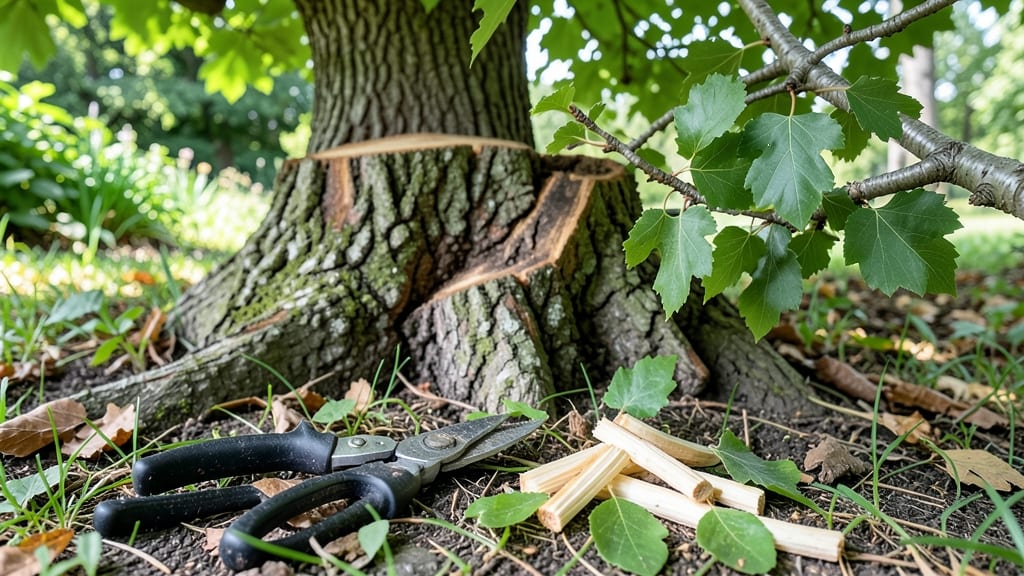
To cut off a tree branch in a crossword puzzle, you'll need to visualize proper pruning techniques—make precise cuts at the branch collar using clean tools, avoid damaging the bark, and prioritize safety with protective gear. Never remove more than 25% of the tree's foliage at once.
Crossword puzzles that reference tree branch removal often test your knowledge of arboriculture basics.
The key is understanding the branch collar, that swollen area where the branch meets the trunk—this is where you should make your cut to prevent damage. 🌳 In real-life pruning, this technique promotes faster healing and reduces the risk of disease.
The crossword's answer might use terms like "branch collar" or "pruning cuts," so recognizing these horticultural terms gives you an edge in solving.
For accuracy, I always recommend visualizing the process: start by identifying the branch collar, then make your cut just outside it at a slight angle. This mimics professional pruning methods that keep trees healthy while solving the puzzle's clues.
The crossword's answer likely expects terms like "branch collar" or "pruning cuts," so understanding these horticultural terms gives you an edge in solving.
💡 In This Article
- Proper Pruning Cuts to Avoid Tree Damage
- Tools and Safety Tips for Removing Tree Branches
Proper pruning cuts to avoid tree damage
When solving a crossword clue about cutting tree branches, the answer often hinges on the branch collar—that thickened area where the branch meets the trunk. This isn't just a random spot; it's nature's built-in healing zone. The collar contains protective tissues that help the tree seal wounds faster.
Making your cut just outside this collar (about 1/4 to 1/2 inch away) mimics professional arboriculture techniques and prevents bark tearing, which is a common mistake that invites disease.
The science behind this involves the tree's vascular system. When you cut too close to the trunk, you sever the branch collar's protective layers, exposing the phloem (the tree's food transport system).
This creates an open wound that can attract pests like bark beetles or fungi. 🌿 A proper cut at the collar preserves these protective tissues while allowing the tree to compartmentalize the wound naturally. Think of it like giving the tree a clean bandage—it heals faster and with less scarring.
For beginners visualizing this, imagine the branch collar as a donut around the trunk. Your cut should be made just outside the "donut's" outer edge, at a 45-degree angle if using pruners. This angle helps rainwater run off the wound instead of pooling inside.
The crossword might use terms like "branch collar cut" or "pruning seal" to describe this technique—recognizing these horticultural terms gives you the edge in solving the puzzle accurately.
Incorrect cuts create what arborists call "stub wounds." These occur when you cut too close to the trunk or leave a large stub. Stub wounds take years to heal and often become entry points for pathogens.
In a crossword context, this might be referenced as "avoiding stub wounds" or "proper pruning cuts." The key is patience—let the tree's natural healing process work by making clean cuts that preserve its protective tissues.
Here's a quick visual reference for crossword solvers: The perfect pruning cut should look like a small, clean slice just outside the branch collar, with no torn bark or rough edges.
This technique isn't just about appearance—it's about giving the tree the best chance to recover. 🌳 In real-life pruning, this method can reduce healing time by up to 50% compared to improper cuts.
For larger branches (over 2 inches in diameter), the process becomes more complex. You'll need to make three cuts: an undercut, a top cut, and a final cut at the collar.
The crossword might reference this as "three-cut pruning" or "branch removal technique." Understanding these variations helps you solve more advanced horticulture-related clues accurately.
The branch collar's importance extends beyond crosswords—it's a fundamental concept in sustainable arboriculture. Trees with properly pruned branches show less stress, grow stronger, and live longer.
This is why professional tree services emphasize collar cuts above all other techniques. 🌿 When you see clues about "tree health" or "proper pruning," remember this collar concept—it's the foundation of all good pruning practices.