
Plants
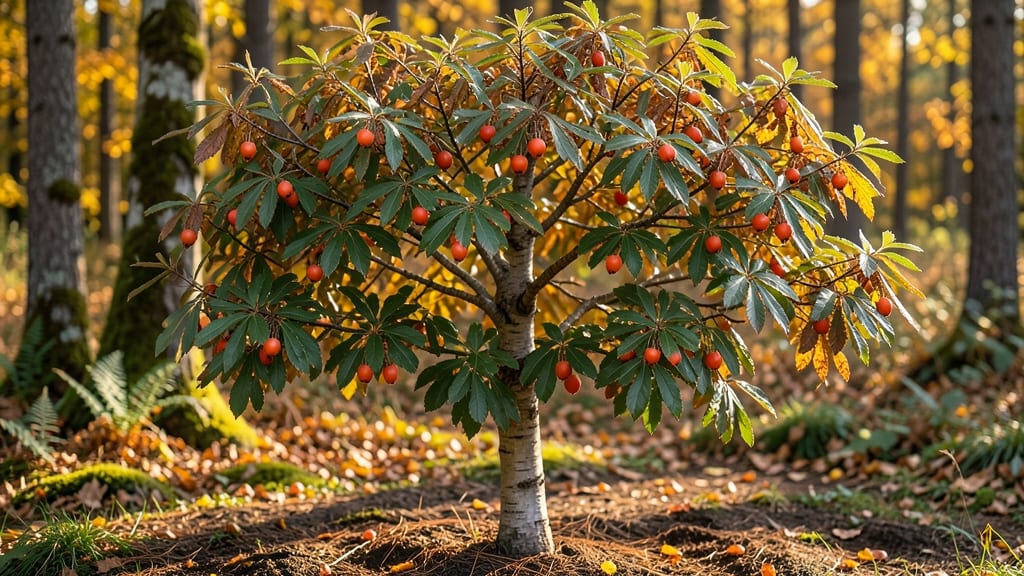
A rowan tree looks like a small to medium deciduous tree with white or pale pink blossoms in spring, glossy dark green leaves that turn fiery red in autumn, and clusters of bright red berries resembling miniature apples. Its bark is smooth and grayish-brown when young, developing shallow furrows with age.
A rowan tree, also called mountain ash, stands out with its striking seasonal transformations. 🌳 In spring, its delicate blossoms create a cloud of pink or white, while summer showcases oval-shaped leaves that shine with a waxy finish.
The real showstopper arrives in autumn, when those leaves blaze into vibrant reds and oranges. Unlike its toxic look-alikes, rowan berries are safe for birds (though not humans) and stay bright red even after frost, often persisting through winter.
This tree typically grows 15-30 feet tall, with a rounded canopy and upward-sweeping branches that create an elegant silhouette. The bark's smooth youthful texture contrasts sharply with its mature, slightly ridged appearance—like nature's own fingerprint.
What really sets rowan apart is how it combines ornamental beauty with hardy resilience, thriving in both gardens and wild landscapes.
💡 In This Article
- Identifying Rowan Tree Leaves, Bark, and Growth Habit
- Rowan Tree Berries: Appearance and Seasonal Guide
Identifying rowan tree leaves, bark, and growth habit
The rowan tree's leaves are its first clue to identification. They grow in alternating patterns along the branches, with each leaf measuring about 2-4 inches long and 1-2 inches wide.
The edges have fine serrations like a saw blade, and the surface has a smooth, almost waxy texture that reflects light beautifully. 🌿 When young, these leaves emerge with a pale green hue, gradually deepening to a rich, glossy dark green that stands out against other foliage.
This glossiness comes from a thin waxy coating that helps repel water and pests.
What truly makes rowan leaves distinctive is their autumn transformation. Starting in late September, the chlorophyll breaks down, revealing the hidden pigments—anthocyanins—that create fiery reds and oranges. Unlike maple leaves that fade to yellow, rowan leaves maintain their vibrant color well into winter, often lasting until the first hard frost.
The tree's bark also evolves dramatically: young rowan trees have smooth, grayish-brown bark that resembles elephant skin, while mature specimens develop shallow, irregular furrows that create a textured pattern resembling cracked clay.
The growth habit of a rowan tree sets it apart from similar species. It typically reaches 15-30 feet tall with a rounded canopy that spreads wider than it grows tall.
The branches grow upward and outward, creating an open, airy structure that allows light to filter through. 🌳 This open branching pattern contrasts with hawthorn trees, which have dense, thorny growth.
The rowan's lack of thorns and its more delicate appearance make it an excellent ornamental choice for gardens, where it can be pruned to maintain a manageable size.
When comparing rowan to its close relative, the mountain ash (which belongs to a different genus), you'll notice several key differences. Mountain ash leaves are typically more elongated and have a slightly rougher texture, while rowan leaves maintain their smooth, almost velvety feel.
Additionally, rowan berries grow in smaller clusters compared to mountain ash's larger, more abundant fruit displays. The bark of mountain ash also tends to develop deeper furrows at a younger age than rowan bark.
One fascinating aspect of rowan's growth is its ability to thrive in challenging conditions.
This tree is incredibly hardy, tolerating temperatures as low as -30°F and growing well in poor, rocky soils where many other trees would struggle. 💪 The combination of its striking seasonal colors, hardy nature, and distinctive physical characteristics makes rowan easily recognizable to experienced gardeners and nature enthusiasts alike.
The rowan's growth rate is moderate, with young trees adding about 12-24 inches per year under optimal conditions. This steady growth, combined with its adaptability, explains why rowan trees are often found in both cultivated landscapes and wild woodlands across Europe and parts of North America.
The tree's ability to grow in both sunny and partially shaded areas adds to its versatility.