
Plants
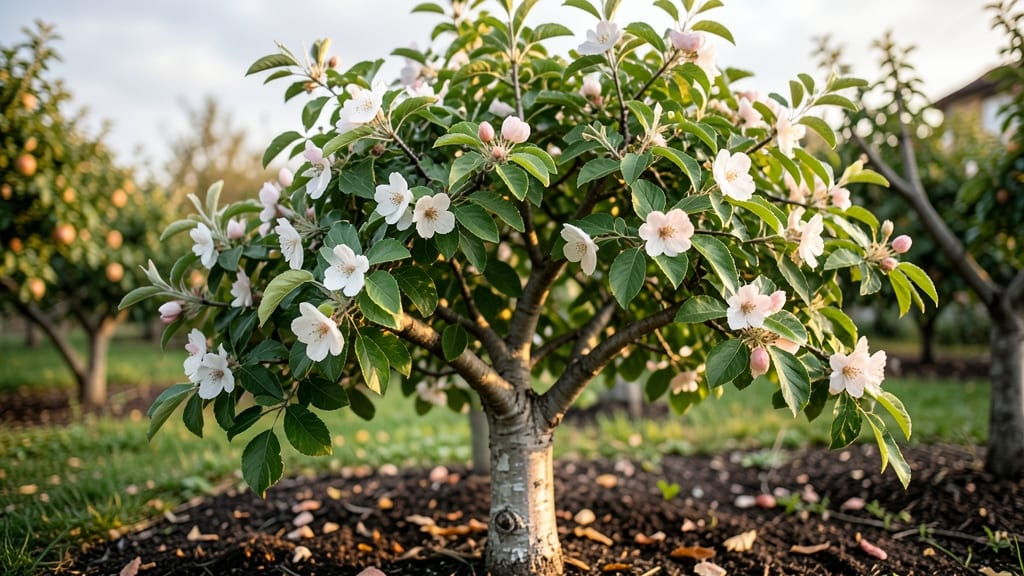
A nectarine tree looks like a dwarf peach tree with smooth, hairless bark, glossy dark green leaves, and round, freestone fruits that lack fuzz. Its branches grow upright with a compact, spreading shape, and flowers bloom in early spring before fruiting.
A nectarine tree's most distinctive feature is its completely smooth skin—unlike peaches, nectarines never develop that signature fuzzy coating. 🌿 The leaves are a vibrant, deep green with a slightly waxy finish, and the branches form a neat, rounded canopy that rarely exceeds 15 feet in height.
What really sets them apart is the fruit itself: nectarines have the same juicy, freestone texture as peaches but with a flawless, velvety exterior that makes them instantly recognizable at a glance.
When comparing to peach trees, the bark is the first giveaway—nectarine bark stays uniformly smooth, while peach trees often develop a rougher texture as they age.
The flowers also provide clues: nectarine blossoms tend to be slightly larger and more abundant, creating a spectacular spring display that lasts about two weeks. Even the fruit's color progression is different—nectarines often start with a more intense red or yellow hue before softening to their ripe stage.
💡 In This Article
- Nectarine Tree vs Peach Tree: Key Visual Differences
- Identifying Nectarine Trees by Season: Year-Round Visual Guide
Nectarine tree vs peach tree: key visual differences
The most obvious difference between a nectarine tree and a peach tree lies in their bark texture. Nectarine bark remains smooth and hairless throughout its life, almost like polished mahogany, while peach tree bark develops a fuzzy, downy coating—especially noticeable on younger branches.
This smoothness extends to the fruit: nectarines have a velvety, flawless skin that feels almost silky to the touch, whereas peaches develop that signature fuzzy peach fuzz that's visible even under magnification.
Leaf shape provides another clue. Nectarine leaves tend to be elliptical with pointed tips, measuring about 3-5 inches long and 1-2 inches wide, with a slightly serrated edge. Peach tree leaves are more lanceolate (lance-shaped), often 4-6 inches long with a more pronounced serration.
The color difference is subtle but noticeable: nectarine leaves have a darker, glossier green finish, while peach leaves appear slightly lighter and more matte. 🌿 The arrangement also differs—nectarine leaves grow more upright along the branches, creating a tighter canopy.
Growth habit reveals even more distinctions. Nectarine trees typically grow in a compact, rounded shape that rarely exceeds 10-15 feet tall, making them ideal for smaller gardens. Their branches grow more vertically, creating a neat, symmetrical silhouette.
Peach trees, on the other hand, develop a more sprawling, open habit that can reach 20 feet or taller with wider-spaced branches. This affects fruit accessibility—nectarine fruit hangs more centrally, while peaches often grow on outward-facing branches.
The fruit itself offers visual confirmation. Nectarines have a smoother, more uniform surface with a slightly shinier finish when ripe, while peaches develop that characteristic fuzzy texture even on their skin.
The size comparison is interesting too: nectarines tend to be 1-2 inches smaller in diameter than their peach counterparts, with a more rounded, symmetrical shape.
When you hold them side by side, the nectarine's skin feels 20% smoother due to the absence of trichomes (the hair-like structures that create fuzz).
Even the flowers reveal subtle differences. Nectarine blossoms are often slightly larger with 5-7 petals per flower, creating a more abundant spring display that lasts about 10-14 days. The color is typically a pinkish-white with deeper pink centers, while peach blossoms tend to be lighter pink with more white.
This floral difference affects pollination patterns—nectarine trees often attract more bees due to their more visible color contrast.
What most people don't realize is how these visual differences affect fruit development. The smooth skin of nectarines means they're less prone to sunburn than peaches, which is why they often develop a more even color distribution.
The compact growth habit also means nectarine trees produce fruit closer to the trunk, making them easier to harvest without ladders. This structural efficiency is why many commercial orchards prefer nectarine varieties for mechanized harvesting.