
Plants
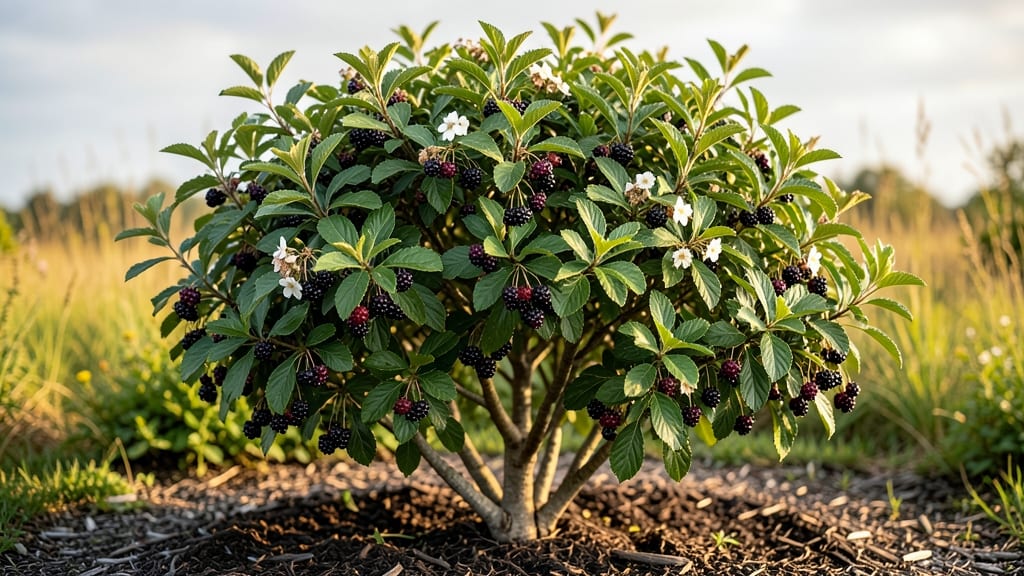
A chokeberry tree looks like a small, dense shrub or multi-stemmed tree with dark green, oval leaves that turn vibrant red in fall. Its slender branches bear clusters of white spring flowers, followed by glossy black berries in late summer, and smooth gray-brown bark that peels slightly with age.
A chokeberry tree's most striking feature is its fall foliage, which transforms into fiery red hues that outshine many maples. 🌿 The berries, though small—about ½ inch in diameter—are packed with antioxidants, making them a prized ingredient in jams and syrups.
Unlike its look-alikes, chokeberry branches grow in a more upright, vase-like shape, rarely exceeding 15 feet tall, while its bark develops a distinctive peeling texture as it matures. This combination of vibrant colors and compact growth makes it a standout in both wild landscapes and cultivated gardens.
The tree's white spring blossoms appear in dense clusters, creating a delicate contrast against the dark green leaves. These flowers later give way to the glossy black berries, which remain on the branches well into winter, providing winter interest.
What sets chokeberry apart from similar shrubs is its smooth, slightly exfoliating bark—a trait that becomes more pronounced with age. This unique combination of features makes identification straightforward once you know what to look for.
💡 In This Article
- Identifying Chokeberry Tree Leaves, Flowers, and Bark
- Chokeberry Fruit and Growth Habit Visual Guide
Identifying chokeberry tree leaves, flowers, and bark
The chokeberry's leaves are its first clue—oval-shaped with finely serrated edges, measuring about 1.5 to 3 inches long and 0.75 to 1.5 inches wide. Their dark green color is rich and glossy on top, while the undersides have a slightly lighter, matte finish.
What's fascinating is how these leaves turn fiery red in fall, often outshining maples, thanks to high anthocyanin levels that develop as chlorophyll breaks down. 🌿 This seasonal transformation is a key identifier, as few shrubs match this intensity of color.
When spring arrives, chokeberry trees burst into clusters of white, five-petaled flowers that grow in dense, upright racemes up to 3 inches long. Each flower is about 0.5 inches wide with delicate, slightly fragrant petals that attract pollinators like bees.
The flowers' arrangement is distinctive—unlike hawthorn's solitary blooms or elderberry's flat-topped clusters, chokeberry's flowers grow in a more conical shape along the branch. These blossoms later develop into the tree's signature fruit, but their early appearance is a crucial identification marker.
The bark tells another story—smooth and gray-brown when young, it gradually develops a slightly exfoliating texture as the tree matures, peeling in thin strips to reveal lighter underlayers. This peeling isn't as dramatic as birch bark but more pronounced than smooth-barked species like dogwood.
The bark's subtle ridges and occasional lenticels (pores) add to its unique character. What makes this feature especially useful is how it distinguishes chokeberry from look-alikes like serviceberry, whose bark remains uniformly smooth.
Here's what sets chokeberry apart from similar shrubs:
- Hawthorn: Thorny branches and lobed leaves (vs. chokeberry's smooth branches and simple leaves)
- Elderberry: Compound leaves and flat-topped flower clusters (vs. chokeberry's single leaves and conical flowers)
- Serviceberry: White bark with horizontal lenticels (vs. chokeberry's gray-brown, peeling bark)
The tree's upright, vase-like growth habit is another key identifier—branches grow in a more vertical pattern, rarely sprawling like elderberry. This compact form, combined with its seasonal color changes, makes chokeberry instantly recognizable to those who know what to look for. 🌟
One final detail: the leaves' leathery texture when mature is a subtle but important clue. Unlike many shrubs with softer foliage, chokeberry leaves have a slight stiffness that's noticeable when touched. This durability helps them withstand harsh winters, contributing to the tree's hardy reputation in colder climates.