
Trees
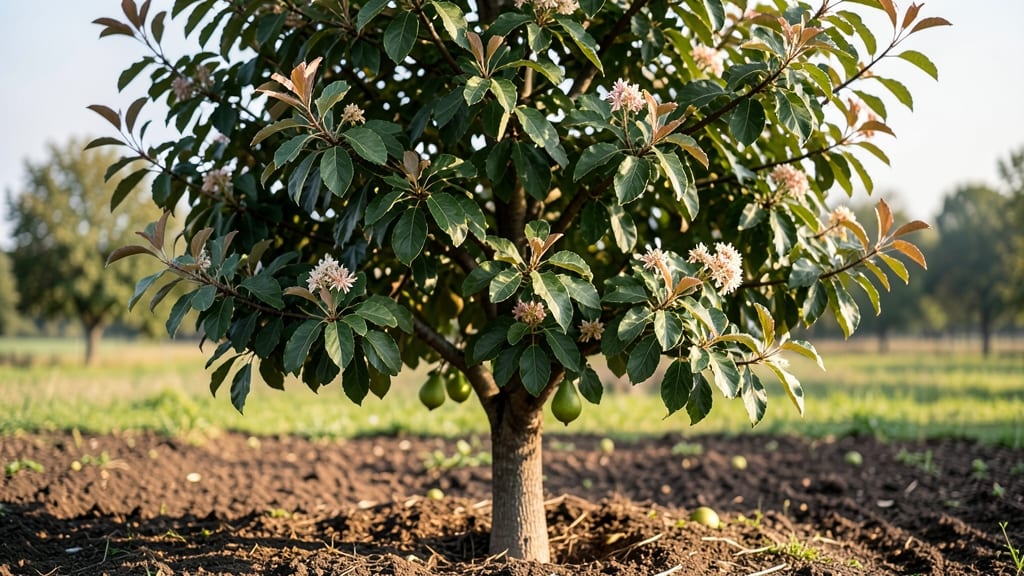
Pear tree leaves look like elongated ovals with sharp points, jagged edges, and shiny dark green tops that contrast with paler undersides. These glossy leaves grow singly along branches in clusters, typically spanning 2–4 inches, and often feel slightly fuzzy when new.
These distinctive leaves help gardeners tell pears apart from other fruit trees—especially when young, since the hairy texture sets them apart from smooth-leaved varieties. 🌿 The serrated edges create a saw-tooth pattern along the perimeter, while the veins form a noticeable network that spreads outward from the central stem.
I've found that comparing them side-by-side with apple tree leaves (which are more rounded) or hawthorn leaves (with sharper points) makes identification much easier during spring pruning season.
What's particularly interesting is how these leaves change throughout the year. In spring, they emerge a bright green but gradually darken as they mature, while fall brings dramatic color shifts from golden yellow to deep bronze depending on the specific pear variety.
The glossy sheen also fades slightly as leaves age, making older foliage appear more matte.
💡 In This Article
- Identifying Pear Tree Leaves by Shape and Texture
- Seasonal Changes in Pear Tree Leaf Appearance
Identifying pear tree leaves by shape and texture
Pear tree leaves typically exhibit an elliptical shape with a pronounced pointed tip, though some varieties show slight variations between elliptical and lanceolate forms. The edges feature serrated margins with sharp, irregular teeth that create a distinctive saw-tooth pattern when viewed closely.
These teeth are usually more pronounced on the upper half of the leaf, tapering toward the base where the leaf attaches to the stem.
The leaf's surface reveals fascinating botanical details: the upper side boasts a glossy dark green hue that reflects light intensely, while the underside displays a paler, almost silvery-green color.
This contrast is particularly noticeable in bright sunlight. 🌿 Young leaves often have a slightly hairy texture along the veins and edges, though this fuzziness diminishes as they mature over 4-6 weeks into a smoother surface.
One key identification feature is the leaf's alternate arrangement along the branches, where each leaf grows singly from a node rather than in clusters.
The vein structure forms a noticeable network with a central midrib and secondary veins that spread outward at roughly 45-degree angles, creating a pattern that's more pronounced than in apple leaves. This vein pattern helps distinguish pears from similar trees like hawthorns, which have more parallel veins.
When comparing pear leaves to their close relatives, the differences become clear: apple tree leaves are more rounded with smoother edges, while hawthorn leaves feature sharper points and often have lobed edges.
The 2-4 inch length of pear leaves also provides a helpful measurement—most varieties fall within this range, though some dwarf varieties may produce slightly smaller leaves. The glossy sheen is another key characteristic that sets pears apart from many other fruit trees.
What's particularly interesting is how the leaf's texture changes with age. New growth often feels velvety due to microscopic hairs, while mature leaves develop a slightly waxy coating that enhances their water resistance.
This natural adaptation helps the tree conserve moisture during dry periods, which is why pear trees thrive in various climates from temperate zones to Mediterranean regions.
For gardeners, understanding these specific characteristics makes identification much easier, especially during the spring pruning season when new growth emerges. The combination of serrated edges, glossy upper surface, and alternate arrangement creates a distinctive "fingerprint" that helps differentiate pear trees from similar species in your landscape. 🌳