
Trees
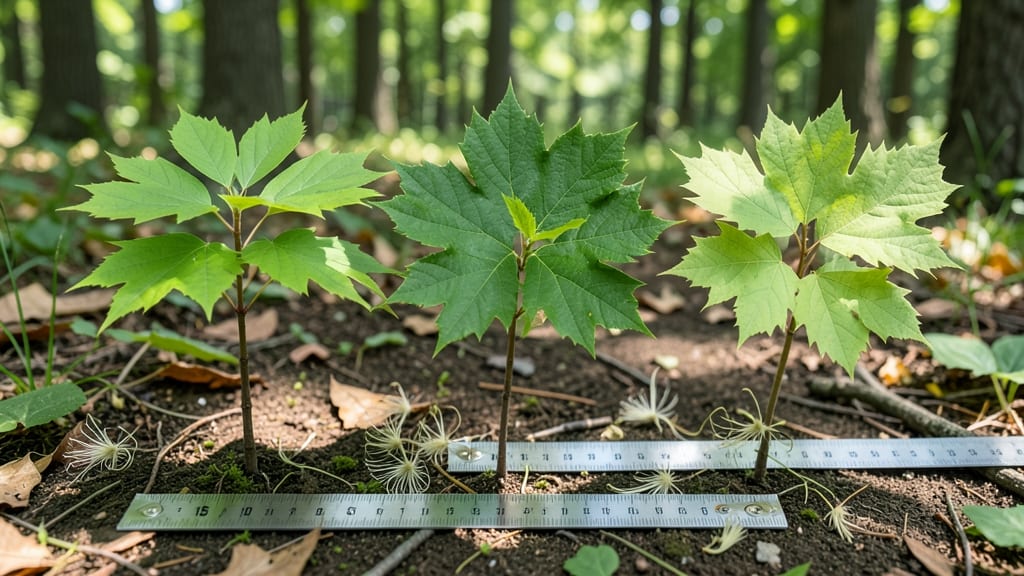
Spotting a maple tree seedling identification starts with those iconic lobed leaves and tight bud clusters. 🌿 I’ve spent years scanning forest edges and my own yard for these telltale signs—sugar maples have 5-7 sharp points, while red maples often show more jagged edges.
The key is catching them early, before weeds or invasive species crowd them out. The first clue is the leaf shape: opposite branching (two leaves at each node) and palmate veins that fan out.
Compare seedlings to reference photos of sugar, red, or silver maples—buds on red maples are often red-tinged, while sugar maples stay greenish. I’ve learned to cross-check with local nurseries to confirm species before transplanting.
Once you’ve identified them, act fast: young seedlings thrive when transplanted in early spring or fall. Monitor for pests or fungal spots, and avoid overwatering—their shallow roots need moisture but hate soggy soil. A few inches of mulch helps them compete with grass.
This works for backyard gardeners, forest stewards, or anyone restoring native woodlands. Grab a magnifying glass and start hunting—you’ll spot them everywhere once you know what to look for!
Understanding Seedling Confusion
Identifying maple tree seedlings can feel like solving a puzzle—especially when similar species blur the lines. Misidentification often stems from a mix of natural biological traits, environmental influences, and human error.
Below, we break down the key reasons why distinguishing maple seedlings can be tricky, along with the science behind each cause.
Maple trees belong to the Acer genus, which includes over 128 species, many of which share striking resemblances in early growth stages. For example:
- Leaf shape overlap: Sugar maples (Acer saccharum) and silver maples (Acer saccharinum) both produce palmate leaves with 3–5 lobes, making them nearly indistinguishable at first glance. Pro tip: 🔍 Examine the leaf edges—sugar maples have serrated (toothed) margins, while silver maples often have smoother, more rounded lobes.
- Bud clusters: Many maple seedlings have paired, opposite buds along their stems, a trait shared across species. However, the arrangement and size of these buds can differ subtly—e.g., red maples (Acer rubrum) have buds that are more elongated and pointed compared to the rounded buds of boxelder maples (Acer negundo).
- Hybridization: Some maples, like the Freeman maple (a hybrid of white and red maples), exhibit traits from both parent species, creating seedlings that defy easy classification. Pro tip: 🌡️ Note the climate zone—hybrids often thrive in transitional areas where parent species overlap.
Seedlings don’t grow in a vacuum—their environment plays a huge role in how they develop, sometimes masking their true identity. Key factors include:
- Light exposure: Maple seedlings grown in shade may develop smaller, less distinct leaves with fewer lobes, mimicking the appearance of a different species. Actionable tip: 🌞 Compare seedlings in full sun vs. shade—sun-exposed maples often show more pronounced lobing and darker green foliage.
- Soil composition: Nutrient-poor or waterlogged soils can stunt growth, leading to compact, underdeveloped seedlings. For instance, a sugar maple in rocky soil might resemble a boxelder due to its stunted, triangular leaves. Pro tip: 💡 Dig 2–3 inches into the soil—healthy maple seedlings should have well-draining, slightly acidic soil (pH 6.0–7.5).
- Seasonal variations: New growth in spring can look drastically different from mature leaves. Young maple seedlings might sprout with simple, unlobed leaves before developing their characteristic shape. Watch for: 🍃 The first true leaves (cotyledons) are often broad and undivided, but the second set of leaves will reveal the species’ true form.
Even the most experienced gardeners can misidentify seedlings if they overlook critical details. Common mistakes include:
- Focusing on wrong traits: Relying solely on leaf color (e.g., red vs. green) or bark texture can lead to errors. For example, a red maple’s vibrant fall foliage is a dead giveaway, but seedlings may not show this trait until years later. Fix: 🎯 Prioritize leaf shape, bud arrangement, and stem structure over superficial features.
- Ignoring the whole plant: Examining just one leaf or bud cluster can be misleading. Maple seedlings should be assessed from root to tip, including:
| Trait | What to Look For |
|---|---|
| Leaf arrangement | Opposite (pairs at each node) or alternate (staggered). Most maples are opposite. |
| Bud shape | Pointed (red maple), rounded (sugar maple), or flat (boxelder). |
| Stem hairiness | Silver maples often have fuzzy stems, while sugar maples are smoother. |
- Misidentifying hybrids: Seedlings from hybrid trees (e.g., Acer × freemanii) may inherit traits from both parents, creating a "mix-and-match" appearance. Solution: 🌿 Cross-reference with local flora guides or consult a botanist if unsure.
By understanding these causes—genetic overlap, environmental pressures, and observational oversights—you’ll sharpen your ability to accurately identify maple seedlings. The key is patience and attention to detail, especially in their early, formative stages.
Fixing Common Maple Seedling Confusions
Got a young maple tree but unsure if it’s the right species? Misidentifying seedlings can lead to poor care—or even planting the wrong tree! Here’s how to correctly identify and address the most common issues when spotting maple seedlings, plus tips to prevent future mix-ups.
Cause: Maple seedlings (especially sugar, silver, and red maples) can appear nearly identical at first glance, with lobed leaves that all seem "similar enough."
Fix It: 🔍 Compare leaf details closely:
- Sugar Maple (Acer saccharum): Look for 5–7 sharp lobes with U-shaped notches between them. The edges are serrated like a saw.
- Silver Maple (Acer saccharinum): Spots 5–7 lobes with pointed tips and V-shaped notches. The underside of leaves is silvery-white (hence the name).
- Red Maple (Acer rubrum): Features 3–5 lobes with rounded tips and U-shaped notches. Young leaves may have a reddish tint in spring.
📏 Measure the leaf: Use a ruler—sugar maple leaves are typically 4–6 inches wide, while silver maples can reach 6–12 inches.
💡 Pro Tip: Snap a photo and compare it to a field guide app (like iNaturalist or LeafSnap) for instant verification.
Cause: Maple buds vary by species, but if yours don’t fit the usual descriptions (e.g., terminal buds too short or lateral buds too long), you might have a hybrid or mislabeled seedling.
Fix It: ✂️ Examine bud placement and shape:
- Sugar Maple: Buds are oval, pointed, and clustered tightly near the stem. Terminal buds are shiny and reddish-brown.
- Silver Maple: Buds are smaller, greenish, and spaced farther apart. They look sticky or resinous when young.
- Red Maple: Buds are egg-shaped, reddish-brown, and slightly sticky. They overlap like fish scales along the branch.
🔥 Quick Test: Gently scrape a bud with your fingernail. Sugar maples release a sweet sap, while red maples may have a bitter or mild taste.
🌡️ Prevention Tip: If buds are abnormally large or deformed, the seedling may be stressed or diseased—check for pests like aphids or scale insects.
Cause: Planting a maple seedling in poor soil or shade can stunt its growth, making identification harder (and care ineffective).
Fix It: 🌱 Assess the environment:
- Sunlight: Most maples need full sun to partial shade. If your seedling is leggy or pale, it’s not getting enough light.
- Soil: Maple seedlings prefer well-draining, slightly acidic soil (pH 5.0–7.0). If the soil is clay-heavy or waterlogged, amend it with compost or sand.
- Space: Seedlings need room to grow—plant them 10–15 feet apart to avoid root competition.
👨🍳 DIY Soil Test: Mix 1 part vinegar + 1 part water, pour on soil. If it fizzes, the soil is alkaline (add sulfur); if nothing happens, it’s acidic (add lime sparingly).
⏰ Prevention Tip: Mulch around the base (but keep it 2–3 inches away from the trunk) to retain moisture and suppress weeds.
Cause: Bugs (like maple leaf skeletonizers) or fungi (verticillium wilt) can alter leaf shape and color, making seedlings look like a different species.
Fix It: 🔪 Inspect for common issues:
- Yellowing leaves? Could be aphids or spider mites. Spray with neem oil or insecticidal soap.
- Black spots or wilting? Likely fungal infection. Prune affected branches and apply copper fungicide.
- Holes in leaves? Japanese beetles or caterpillars are likely. Use row covers or milky spore bacteria for long-term control.
🎯 Prevention Tip: Water seedlings at the base (not overhead) to reduce fungal spores. Prune regularly to improve airflow.
Final Reminder: When in doubt, consult a local arborist or university extension service—they can provide free or low-cost identification and care advice! 🌳✨
Frequently asked questions
How do I tell the difference between a sugar maple and red maple seedling?
Look at the leaf lobes and edges: sugar maple seedlings have 5-7 sharp lobes with U-shaped notches and serrated edges, while red maples show 3-5 lobes with rounded tips. Check the buds too—red maples often have reddish buds, while sugar maples have greenish-brown ones. Young red maple leaves may also have a slight reddish tint in spring.
Can I identify a maple seedling just by looking at its first leaves?
The first true leaves (cotyledons) often look similar across maple species, but the second set of leaves will reveal key differences. Focus on leaf shape, lobe count, and arrangement—most maples have opposite branching (two leaves at each node). Use a magnifying glass to examine the leaf edges and vein patterns for more precise identification.
Are there any dangerous look-alikes I should avoid?
Yes! Boxelder maples (Acer negundo) can resemble sugar maples but have 3-5 lobes with pointed tips and compound leaves. Avoid planting them—they spread aggressively and can become invasive. Another look-alike is the Norway maple, which has 5-7 lobes with rounded tips and can outcompete native species. Always cross-check with local flora guides.
How do I know if a seedling is healthy enough to transplant?
Healthy maple seedlings should have vibrant green leaves, no signs of pests, and a firm root system when gently lifted. Avoid transplanting during extreme heat or cold, and water thoroughly 24 hours before moving. Early spring or fall are ideal times—seedlings transplant best when they're dormant or actively growing.
What should I do if I find a maple seedling but can't identify it?
Take clear photos of the leaves, buds, and bark, then compare them to a field guide or use an app like LeafSnap. If unsure, consult a local arborist or university extension service—they can provide expert identification and care advice. For rare species, consider submitting samples to a botanical garden for confirmation.