
Trees
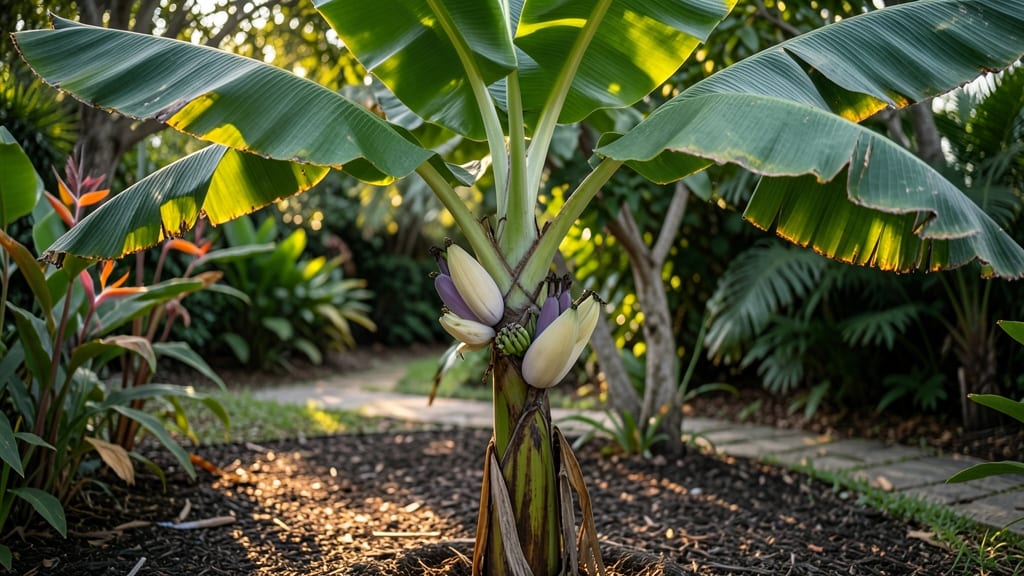
Banana trees need tropical or subtropical climates with steady warmth, high humidity, and regular rainfall to flourish, as they cannot tolerate frost or temperatures dropping below 50°F (10°C).
Banana trees are tropical natives, so their growth depends on consistent warmth—ideal daytime temps hover between 75°F and 85°F (24°C–29°C), while nights should stay above 60°F (15°C). 🌴 Without this heat, their metabolism slows, stunting growth and preventing fruit production.
Humidity also plays a critical role: levels below 60% cause leaf edges to brown, while steady moisture mimics their rainforest origins. Even in frost-free zones, sudden cold snaps can shock the plant, making microclimate protection essential for marginal growers.
In regions with cooler winters, growers often use containers to move plants indoors or wrap trunks with insulating materials. This creates a protective microclimate that mimics the tropical conditions banana trees crave.
Understanding these climate needs helps gardeners choose the right variety—some dwarf types tolerate slightly cooler temps better than larger commercial varieties.
💡 In This Article
- Banana Tree Temperature and Humidity Requirements
- Best USDA Hardiness Zones for Growing Banana Trees
Banana tree temperature and humidity requirements
Banana trees are tropical powerhouses that rely on a delicate balance of warmth and moisture to thrive. Their ideal daytime temperature range sits between 75°F and 85°F (24°C–29°C), mimicking the equatorial conditions of their native rainforests.
At these temperatures, photosynthesis operates at peak efficiency, fueling rapid leaf growth and energy storage for fruit development. When temperatures dip below 60°F (15°C) at night, the plant's metabolic processes slow dramatically, leading to stunted growth and poor flowering.
The humidity factor is equally critical—banana trees crave air moisture levels above 70% to prevent leaf desiccation. In dry climates, you'll notice browning edges on leaves as the plant struggles to retain moisture through its broad, porous surfaces. This is why tropical regions with consistent rainfall provide perfect growing conditions.
Rainfall also plays a dual role: it replenishes soil moisture while leaching excess salts that could otherwise accumulate and damage roots. Without this natural cycle, growers must supplement with frequent irrigation and mulching to replicate the tropical moisture balance. 🌧️
Cold snaps are the silent killers of banana trees, with frost being especially devastating. When temperatures drop below 50°F (10°C), the plant's cellular structure begins to break down, particularly in the pseudostem (the tree's false trunk).
This is why even brief cold snaps can cause irreversible damage, leading to blackened leaves and rotting tissue. The plant's vascular system becomes clogged with ice crystals, disrupting nutrient and water transport.
This explains why banana trees in marginal climates require protective measures like windbreaks or greenhouse structures during cooler months.
Interestingly, different banana varieties exhibit varying degrees of cold tolerance. Dwarf dessert bananas, for example, can handle brief exposures to 55°F (13°C) better than larger plantains, which are more sensitive to temperature fluctuations.
This genetic variation allows some growers in subtropical zones to successfully cultivate hardier varieties with proper microclimate management. The key is understanding your specific variety's tolerance limits and adjusting care practices accordingly.
Rainfall patterns also influence fruit development directly. Bananas require consistent moisture during the flowering stage, as the developing fruit relies on steady water uptake to expand properly. In regions with seasonal dry periods, growers often implement drip irrigation systems to maintain soil moisture at optimal levels.
The plant's shallow root system means it can't access deep water reserves, making surface-level hydration absolutely critical for successful fruiting. This is why banana trees in arid climates often produce smaller, less flavorful fruit compared to their tropical counterparts.
For those growing banana trees in containers, maintaining proper humidity becomes even more challenging due to the limited soil volume. Using humidity trays filled with pebbles and water beneath pots can create a localized microclimate that raises ambient moisture levels around the plant's leaves.
Additionally, misting leaves in the early morning helps replicate the natural dew cycles of tropical environments, providing both moisture and a slight temperature buffer against afternoon heat spikes. These small adjustments can make the difference between a thriving banana tree and one struggling to survive in less-than-ideal conditions. 🌿