
Pruning
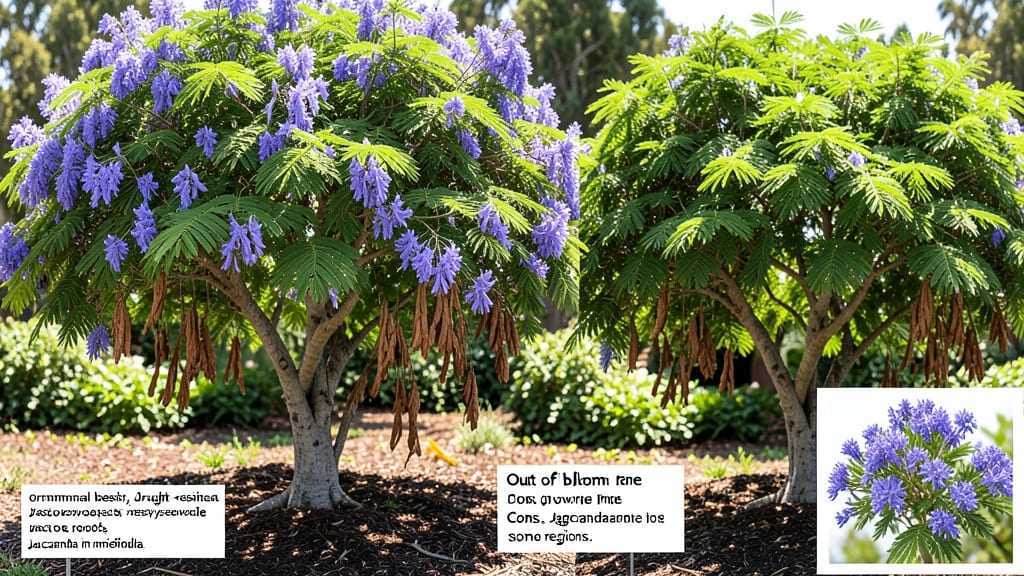
Considering jacaranda tree pros and cons reveals a striking ornamental with rapid growth and vibrant blooms, perfect for warm climates, but demands full sun exposure, well-draining soil, and careful management of its invasive tendencies and fragile branches.
Jacarandas shine as dramatic focal points in landscapes, especially in USDA zones 9-11, where they thrive with minimal care. Their 3-foot annual growth and drought tolerance make them low-maintenance once established, but their messy shedding and deep roots can create headaches. 🌿 The trade-off?
Few trees deliver such a spectacular purple canopy in spring—ideal for Mediterranean-style gardens or tropical climates where they flourish without extra effort.
What sets jacarandas apart is their fast maturation—you’ll see blooms within just 3-5 years, unlike slower-growing ornamentals. However, their brittle wood often snaps in storms, and their aggressive roots can crack driveways or lift sidewalks over time.
In regions like Florida or California, where they’re considered invasive, removal may be necessary to protect native ecosystems.
💡 In This Article
- Jacaranda Tree Growth Habits and Climate Adaptability
- Jacaranda Tree Care Challenges and Invasive Risks
Jacaranda tree growth habits and climate adaptability
Jacarandas thrive in USDA zones 9-11 due to their native adaptation to Australia's arid regions, where they've evolved to handle dry conditions and intense sunlight.
Their rapid growth—up to 3 feet per year—stems from a combination of shallow, wide-spreading roots that efficiently capture moisture and a growth cycle triggered by warm temperatures.
Unlike slower-growing trees like oak, jacarandas prioritize vertical expansion during their first decade, reaching 30-50 feet at maturity with a 20-40 foot spread, creating an expansive canopy that casts dramatic shade.
Their drought tolerance comes from a specialized leaf structure that minimizes water loss, with waxy coatings and a tendency to shed foliage during extreme dry spells.
This adaptation explains why they flourish in Mediterranean climates like Southern California or tropical zones like Hawaii, where they receive 6-8 hours of direct sunlight daily.
The blooming cycle is equally impressive—jacarandas typically flower for 4-6 weeks in spring, producing 1,000-2,000 flowers per tree, each with six 2-inch-long petals that create a mesmerizing purple haze. 🌸 Unlike royal poincianas (which bloom in summer) or frangipani (year-round in tropics), jacarandas offer a concentrated, high-impact display that transforms landscapes overnight.
What makes jacarandas uniquely adaptable is their ability to establish quickly in well-draining soil, even in poor-quality substrates. Their roots grow aggressively horizontally, spreading 2-3 times wider than their canopy—a trait that helps them access water but also explains their potential for invasiveness.
In ideal conditions, a jacaranda can grow 50% faster than comparable ornamental trees like crape myrtles, which typically grow 1-2 feet per year. This rapid growth means they reach flowering age in just 3-5 years, compared to 7-10 years for many other shade trees.
However, this fast growth comes with trade-offs. The lightweight branches, while lush, are prone to wind damage—especially in coastal areas where salt spray can weaken the wood. Their brittle nature means even moderate storms can strip entire limbs, creating cleanup headaches.
The deep root system, while beneficial for drought resistance, can become problematic when planted near sidewalks or foundations, where roots may seek moisture from irrigation systems or plumbing. 🌪️ In regions with seasonal rainfall patterns, jacarandas may also experience leaf drop during dry periods, which can be mistaken for poor health when it's actually a natural adaptation.
For gardeners comparing jacarandas to other flowering trees, the key differentiator is their visual impact versus maintenance ratio. While royal poincianas offer similar dramatic blooms, they require more frequent pruning due to thorny branches.
Frangipani trees produce fragrant flowers but grow much slower (1 foot per year) and are less cold-hardy. Jacarandas strike a balance—fast growth, minimal care (once established), and unmatched seasonal color—making them ideal for low-maintenance landscapes in warm climates.
One often-overlooked advantage is their pollinator appeal. Jacaranda flowers attract hundreds of bees and butterflies during bloom season, supporting local ecosystems.
The tree's lightweight seeds (each about 1/4 inch long) are dispersed by wind, which explains their invasive potential in some regions but also their ability to self-sow naturally in suitable climates.
This dual nature—both a garden star and ecological player—is what makes jacarandas so compelling for the right location.